From Awareness to Spend: The Shopper Engagement Playbook for Retail Destinations

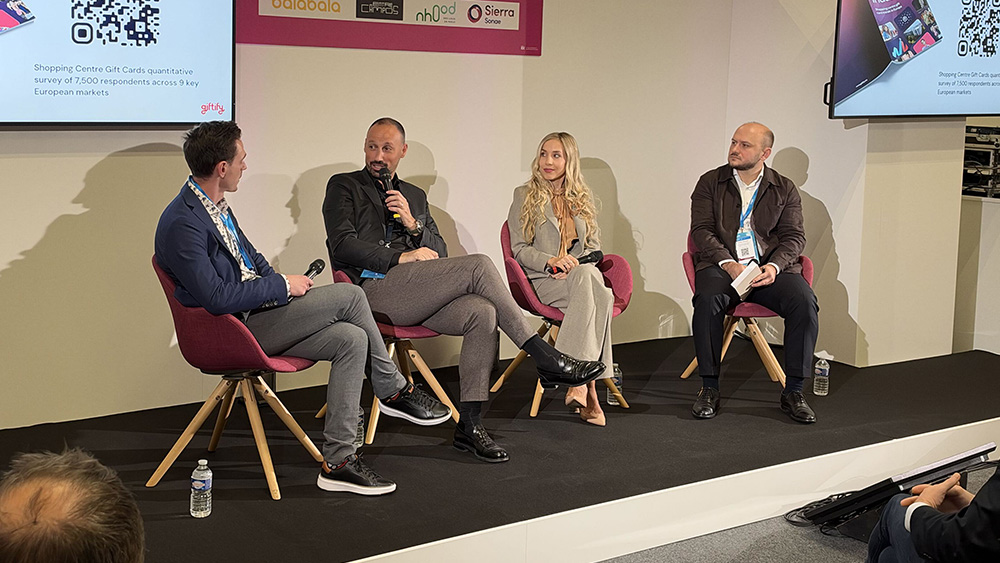
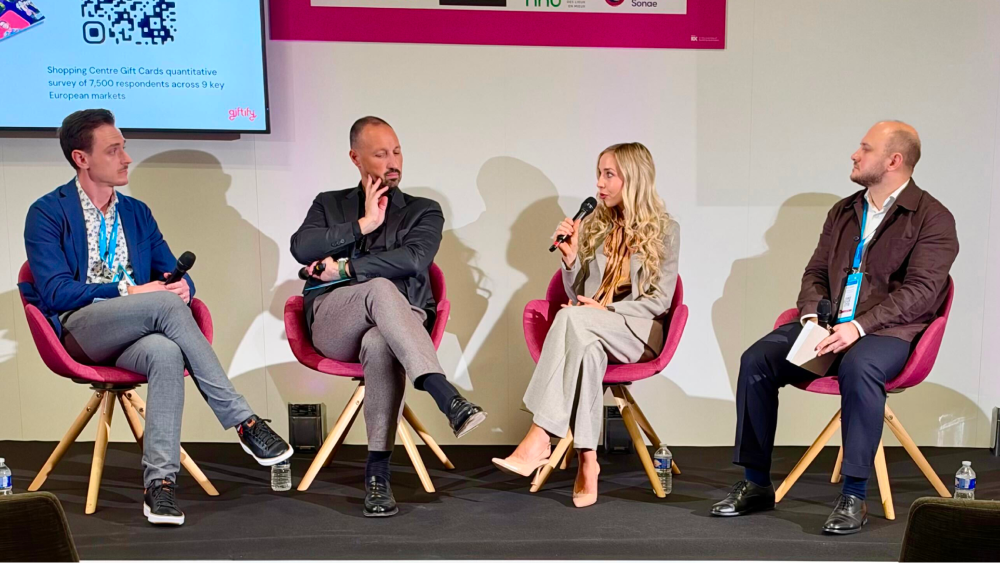
At MAPIC, Giftify hosted a panel discussion exploring the relationship between shopper awareness, engagement and spending, drawing on findings from its European consumer survey involving more than 7,500 respondents.
Moderated by Michael Pasket, VP of Malls at Mappedin, the discussion brought together:
- Jorge Loconsole, Head of Marketing & Tourism, VIA Outlets
- Michaela Šoková, Client Success Manager, Giftify
- Artem Shostak, Chief Marketing Officer, Giftify
From the importance of authentic communication to the role of loyalty programmes, gift cards and customer data, the speakers discussed what works in practice, how strategies differ across European markets and where retail destinations should focus their efforts.
Awareness: Getting shoppers through the door
Michael Pasket: Marketing starts with awareness. We have plenty of examples of how awareness drives demand and influences behaviour online, but physical destinations are different.
Jorge, how does awareness work for retail destinations? Do your communication campaigns actually influence shopper behaviour, and if so, how?
Jorge Loconsole: Whether it's online or physical, awareness needs to be there to drive people to your website or destination.
The big difference is that online is just a click away. With physical destinations, people really need to take the time, get into the car and sometimes drive two or two and a half hours to visit. So expectations are much higher.
What we see when building our awareness campaigns is that the real voice of our guests, feedback from customers, friends and family, is much more important than a nice advertising campaign.
In advertising, you can say whatever you want. But if you invite influencers to your centre and let them speak authentically about the experience, that really pays off.
I always say that online is transactional, while physical is more emotional. And that's what we try to build on.
Michael Pasket: That's true. People have to make an effort to go somewhere, whether it's 15 minutes or two hours away. The experience has to meet those expectations.
Artem, Michaela, how do gift cards play a role in that?
Michaela Šoková: When I talk to shopping centre clients about gift cards, I usually ask them a simple question: can a shopper find your gift card within ten minutes of entering your shopping centre?
Sometimes you don't need a huge campaign. You just need to make the right offer visible at the right moment.
If shoppers don't know about something, they can't buy it. And when customers are already in your shopping centre, the opportunity is there. You simply need to make sure they can see the offer.
Michael Pasket: Artem, how do you look at this from a marketing perspective?
Artem Shostak: I would add that marketers often treat awareness as an objective in itself, which is questionable.
The question should always be: what is the purpose of this awareness? What behaviour are we trying to encourage?
Is it to generate more visits? More purchases? Higher spending? Gift card sales?
Awareness campaigns are important, but they need to have an end goal.
Let me give you an example from one of our clients, Unibail-Rodamco-Westfield. We recently launched a gift card programme at Westfield London, one of the largest shopping centres in the UK.
To boost the programme, we launched a "Thank You Teacher" promotional campaign at the end of the school year.
Westfield London is an extremely popular destination. They don't have a problem generating awareness or attracting people to the shopping centre, and gift cards were already well known there.
Yet, after the campaign, we analysed the results and found that gift card sales in June had increased by 36% compared with the previous year.
The difference was that we connected awareness with a specific action. We gave customers a reason to purchase.
One Europe, different markets: What works where?
Michael Pasket: Europe is a big place, with many countries and different markets. How do you approach shopper engagement from one market to another?
Can the same strategies work across countries, or do you need to treat each market separately?
Jorge Loconsole: I always say: build the brand centrally, but drive visits locally.
Our general concept comes from a group perspective, but then you need to look at individual markets and understand what works best in each one.
In some markets, you can communicate in English. In others, customers really want communication in their local language.
Some markets are also much more price-driven. In Spain and Iberia, for example, discount-led campaigns tend to work better than in the Nordics.
We once ran a magazine campaign connected to certain shopping weekends. It worked extremely well in the Netherlands. We copied exactly the same concept in Switzerland, and it didn't work at all.
That's why you cannot simply copy and paste. You need to understand what drives customers in each market and adapt your approach.
But there are also examples of initiatives that can be transferred successfully.
In Spain, we introduced Super Jueves, or Super Thursdays, a special promotional event on Thursdays. It has been very successful there.
We started introducing the concept in the Nordics as well. Initially, it didn't work, but after six or nine months of persistence, it started gaining traction.
Sometimes you need to introduce a concept and give customers time to become familiar with it.
Michael Pasket: Are there tactics that work across most markets, or is it always about fine-tuning for each region?
Jorge Loconsole: Some things work everywhere, but there are differences even between social media platforms.
Snapchat, for example, is very popular in the Nordics, but it doesn't work nearly as well in Southern Europe. Instagram and Facebook work across markets.
With influencers, you also see differences. In some countries, more promotional and aggressive approaches work better than in others.
But what we consistently see is that people appreciate authenticity. When you show what your centres really look like and communicate the actual experience, people respond to that. They don't want fake messages.
Michael Pasket: Artem, how does this compare with gift cards? I assume they're not discovered or used in the same way across all markets.
Artem Shostak: I'm fully aligned with Jorge. Anyone who lives in Europe knows how different these markets can be.
When we talk about successful tactics across markets, we should remember that while the proposition can be standard, the execution has to adapt to local realities.
We see this clearly in how people discover shopping centre gift cards.
For example, in France, word of mouth is one of the major channels. 17% of respondents in our survey said that's how they learned about shopping centre gift cards.
In Poland, it's only 2%.
But in Poland, information desks are a major channel. 24% of respondents learned about gift cards through the shopping centre information desk.
So if you're a shopping centre in Poland and your information desk doesn't have visible information about gift cards, you're missing an opportunity.
In the Netherlands, for comparison, the figure is only 10%.
That's why, while your proposition can be standardised, your execution has to be localised.
Increasing spend: Loyalty, incentives and gift cards
Michael Pasket: Giftify's survey found that 83% of gift card users actually spend more than the value of their gift card, with around a third spending €25 or more beyond that value.
Jorge, what are some simple, proven tactics to increase spending per visitor when they're already on-site?
Jorge Loconsole: One of our most successful tools is our loyalty programme, Fashion Club.
It's very effective in driving higher spending because we see that our loyalty members spend up to 38% more than non-loyalty members.
For us, it's important to get people into the programme and encourage them to spend more.
It's a very simple mechanism. Every time people shop, they save 5%, and on their next shopping trip they can already redeem part of what they've saved.
It's tangible. People feel like they have money available to spend, and that works very well.
We also run campaigns where customers receive an additional gift when they reach a certain spending level.
For example, during our summer campaign, we offered beach bags and beach towels. If the average spending was around €150, we encouraged people to spend €250 to receive the gifts.
We use similar campaigns during Christmas, with gifts such as candles.
Another tactic is using gift cards to encourage customers to start spending.
In some countries, people are still not fully aware that gift cards exist. So we sometimes run campaigns offering visitors a €30 or €40 gift card to start shopping.
They discover the gift card, use it, and often realise they can buy one as a gift for someone else.
So gift cards can encourage spending and, at the same time, introduce more people to the product.
Michael Pasket: Michaela, how do you see gift cards helping shopping centres increase spending?
Michaela Šoková: What I like about gift cards is that people come to a shopping centre already happy. They're using a gift, so they don't feel like they're spending their own money, even though they often end up spending more.
But gift cards can also help shopping centres win customers from competitors.
Let me give you an example from the Czech Republic, where the shopping centre market is very competitive.
One of my clients runs a campaign every year where customers receive an additional 20% on top of the value of the gift card.
This helps secure the customer's visit to that particular shopping centre rather than a competing destination.
So especially in a competitive environment, gift cards can be a way to attract customers and influence where they decide to shop.
More visits or higher spending? It depends on the customer
Michael Pasket: Jorge, from your perspective, what's more important: bringing people back more often or increasing their spending while they're already at your destination?
Jorge Loconsole: It really depends on who the customer is.
For local and domestic customers, the first priority is to bring them into our loyalty programme. Once they're members, we want to increase their spending with each visit.
We use RFM models to understand when people visit, how frequently they come and how much they spend. This helps us focus on customers who generate the most spending.
But tourists are different.
With tourists, we first want to bring them to the centre. And what we see is that tourists spend five, six or even seven times more than local guests.
So the priority is to attract them and then encourage them to spend as much time as possible at the destination.
We do that through good food and beverage options, access to lounges, tax-free shopping, cashback services and experiences such as styling advice.
The idea is to extend their dwell time so they go home with full shopping bags.
And that's literally what happens. When the tourist coaches arrive, some people first go to stores like Samsonite, Delsey or Rimowa, buy an empty suitcase and then go shopping with it.
That's the kind of visitor behaviour we're trying to support.
Michael Pasket: I have to admit, I didn't initially see how gift cards could help attract tourists until I spoke with Artem and Michaela a couple of days ago.
Can you explain how gift cards can be used to attract tourists and encourage them to spend more?
Michaela Šoková: Shopping centres often collaborate with nearby hotels and organise cross-promotional activities.
Gift cards are a very useful tool for this. Hotels can give gift cards to their guests, and for the shopping centre, it's an opportunity to attract new customers who will spend money at the destination.
Artem Shostak: We also work in the Middle East, where we see gift cards becoming part of a broader lifestyle experience.
Shopping centres often develop their own lifestyle-focused super apps. And their property management groups sometimes manage other spaces as well, including airports.
These locations create opportunities to promote gift cards.
For example, tourists arriving in a country might receive a gift card worth €5 or €10 as an incentive to visit a particular retail destination.
And Michael, coming back to your earlier question about whether to prioritise visit frequency or spend, I think the most important thing is to measure and understand the data before making that decision.
There's often a temptation in marketing to focus on increasing footfall, assuming everything else will follow.
But I would first look at spend per visit, dwell time and footfall, and try to understand where the gap is.
Sometimes, increasing spending isn't about promotions or financial incentives at all. It's about removing friction from the customer journey.
Sometimes the biggest opportunity is simply making things easier
Artem Shostak: Let me give you two numbers from our survey.
25% of respondents who were aware of shopping centre gift cards said they didn't buy them because they didn't know which shops would accept them.

So simply providing clear information about the acceptance network could potentially increase gift card sales significantly.
And 60% of respondents who had never heard of shopping centre gift cards identified the acceptance network, meaning the number of participating merchants, as a major factor that would influence their choice between a shopping centre gift card and a single-brand gift card.
So this isn't necessarily a promotional question. It's a technical and practical question.
It's about removing friction.
Michael Pasket: That's a good point, because when I think about shopping centre gift cards, I naturally assume that every store in the centre accepts them.
Jorge, how do you communicate which stores accept gift cards and make that information clear to customers?
Jorge Loconsole: We do it in several ways.
First, on our website, where people can order gift cards online and see which stores accept them.
In our centres, acceptance is usually very high, close to 100%, sometimes around 98%.
We also communicate it inside the centres. Stores have information about accepted payment methods near their entrances and at the counters.
And especially around gifting occasions, such as Christmas, Mother's Day and Father's Day, we advertise gift cards on digital screens throughout the centre.
We show customers where they can buy gift cards and where they can use them.
So we try to make that information available in multiple places.
Digital convenience and physical gifting: Why shoppers want both
Michael Pasket: The survey also found that 74% of Europeans expect to be able to buy a gift card online, while 66% expect to receive a physical gift card.
There's an interesting difference in those expectations.
Jorge, how do you handle that, and how does it influence shopper engagement?
Jorge Loconsole: For me, digitalisation should always be about removing friction.
Digital screens, digital processes, digital services: they are useful when they make things easier.
The moment digitalisation stops removing friction and starts creating extra work, people don't want to use it. They might try it once, but they won't necessarily come back to it.
When we translate that into gift cards, being able to purchase a gift card online is a must-have.
But at the same time, people still appreciate the act of giving a gift. They like handing someone a physical gift card. There's an emotional element to that.
So it's about combining both.
You want quick access to a gift card and the convenience of buying it online. Then you might have it sent to your home or collect it at the information centre.
But once you have it, you still want to physically hand it over to someone.
Digital plays an important role in making the purchase easier, while the physical element remains important for the gifting experience.
Connecting the digital and physical customer journey
Michael Pasket: We're adding more and more digital touchpoints to the shopping journey, but are we actually understanding that journey any better?
How do you connect what happens on a computer at home with what's happening on-site, on digital screens or inside the physical destination? And how do you use that information?
Jorge Loconsole: That's a journey we've really started working on over the last year and a half.
There's so much data available today that sometimes it's difficult to see what's actually important.
The question is which data we're going to use and how we're going to connect it.
Instead of working with separate data silos, we've started building our own customer data platform.
The idea is to bring everything together: footfall counters, licence plate data, gift card data, loyalty programme data, weather, media performance and other available information.
We want to have it in one place so we can analyse it together.
With AI, it's becoming easier to get useful outputs from that data.
I think that's where the future is. Instead of having information scattered everywhere, we bring it together.
It might not give us complete clarity immediately, but it helps us better understand where to focus.
Michael Pasket: Artem, how can gift cards help operators better understand that customer journey?
Artem Shostak: In this case, we're a data supplier.
We provide information about spending patterns, seasonality, the popularity of different tenants and other aspects of gift card usage.
But coming back to the point about digital versus physical expectations, we try to remind our customers that digitalisation is simply a means of improving the customer journey.
What Jorge described is exactly right. If you're adding technology just for the sake of looking more technological, you might actually be adding friction for your shoppers.
Technology should simplify the journey.
So we focus on what customers expect, whether that's digital gift cards or the ability to purchase online, while making sure shopping centres can continue doing what they do best: providing a good customer experience.
Which technologies are making a difference today?
Michael Pasket: Jorge, which technologies do you think are making a real difference to the shopper experience right now, particularly at scale?
Jorge Loconsole: I think one of the biggest opportunities, especially with AI, is personalisation.
In the past, communication was much more one-to-many. Now it's moving towards one-to-one.
For example, if we know that Michael regularly shops at a particular store, we can give him personalised information about that store.
We're also looking at how sensors and customer data can help us understand footfall, where people spend time in the centre and which brands customers tend to visit together.
If someone shops at brand X, do they also shop at brand Y?
And we're looking at making things easier through cash-free payments, digital tax-free refunds and similar services.
These are the technologies we're focusing on because they can remove friction from the shopping experience.
Who actually owns shopper engagement?
Michael Pasket: A lot of what we've discussed comes back to engagement.
So who is actually responsible for shopper engagement at VIA Outlets? Is there one person, one department, or is it a shared responsibility?
Jorge Loconsole: I think it's definitely not a one-man show.
Every department has a role to play.
Marketing is important because it brings customers to the centre in the first place.
But once customers arrive, it's the operations team's responsibility to make sure the centre looks good, everything is clean and facilities like toilets are in perfect condition.
Then you have the retail and visual merchandising teams, who create an attractive shopping environment and encourage customers to enter the stores.
And you have the staff at information points and in the stores themselves.
All these people contribute to the customer experience.
Because if customers have a bad experience, that's what they remember, and they might not come back.
That's also why we have shared KPIs across different departments.
We look at things like Net Promoter Score and the voice of our guests.
These aren't the responsibility of just one person or one department. The whole team is responsible for them.
Artem Shostak: We see the same approach with other clients.
What Jorge describes is a good example of how teams can coordinate around shared KPIs for engagement and customer satisfaction, rather than treating them as something that belongs exclusively to marketing.
For example, we work with a client that has created a separate customer experience department.
That department focuses on coordinating efforts across different teams, with customer experience as its main KPI.
So there's a clear organisational responsibility for making sure everyone is working towards the same objective.


Related posts